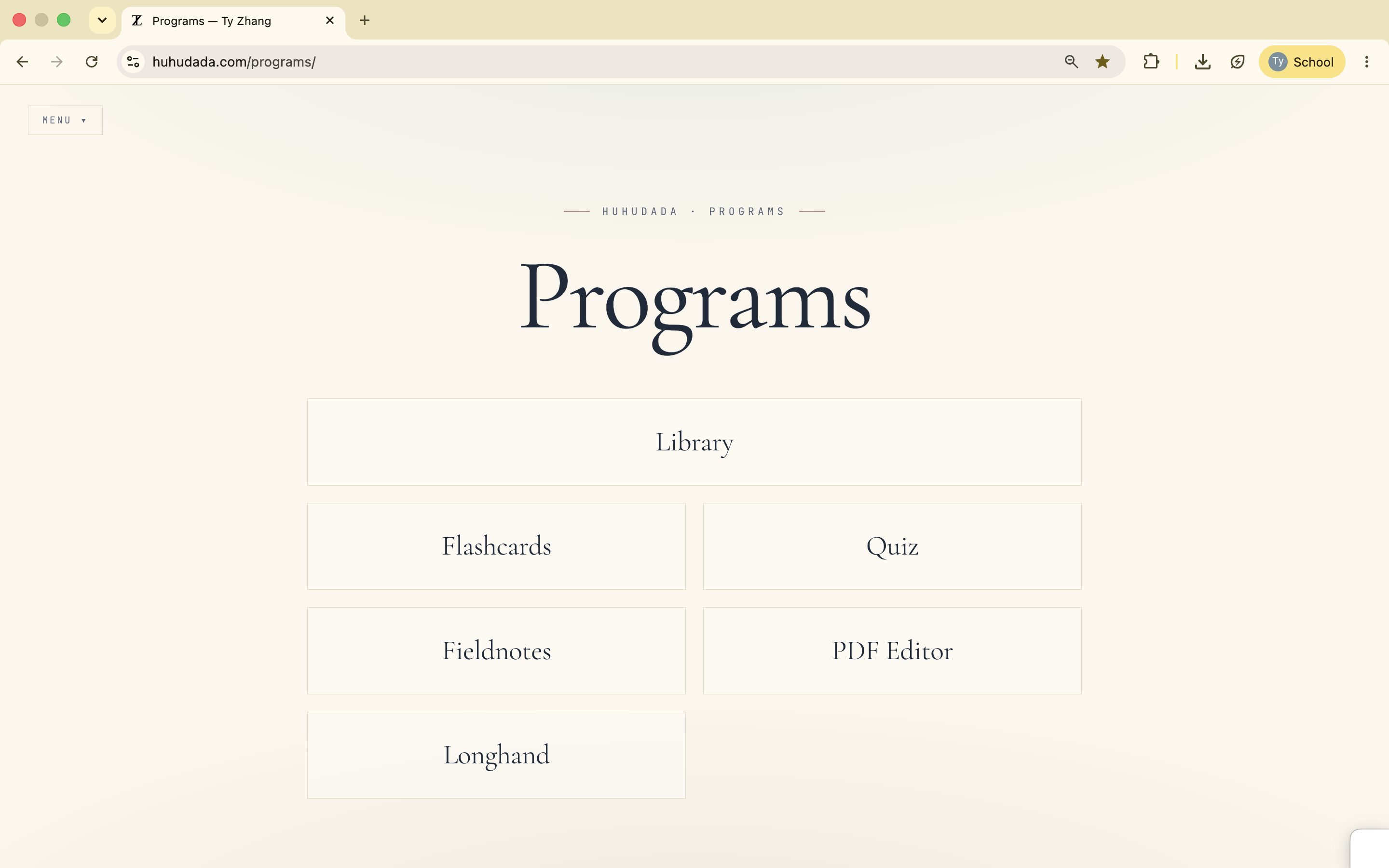
Fig. 01 — The programs index
A suite of browser-based study programs built into this site. Flashcards, quizzes, and sectioned reference notes all read the same plain-text file, and a self-building library indexes every file in the repository and makes it browsable and filterable.
Study tools tend to keep your material inside an account and hand it back only as a proprietary export. Switch tools, or lose access, and a semester of typed-out cards has to be rebuilt from scratch. The material is the valuable part; the app around it is not.
So the constraint came first: every deck, quiz, and set
of notes is a plain .txt file committed to
the repository. It opens in any text editor, diffs
cleanly, and is versioned for free. The programs are
readers for those files rather than owners of them.
Every study file opens with the same four-line header — title, description, class, and semester — followed by a body whose line prefixes say which program the file is for:
Q: and A: pairs make a flashcard deckQ: with lettered options, an asterisk on the correct one, and an Explain: line makes a quizS: sections with N: notes beneath them make a fieldnoteThe files are self-describing, and that is the design decision the rest follows from. The library reads each file's own header for its title, course, and term, and counts the body lines for its item count — so there is no separate index of metadata to keep in sync, and adding a file is a one-step operation.
The library lists its storage folder through the GitHub
Contents API, with a committed manifest as a fallback
when the API is unavailable; a GitHub Action regenerates
that manifest whenever a file is pushed. Everything else
runs in the browser — no backend, no accounts — and
review progress lives in localStorage.
All four are built on the site's design system, so a program looks like the rest of the site rather than like an embedded app — the same palette, the same three typefaces, the same hairline borders. They also share a structural template: the same corner navigation in the same position, a settings page with export and import, and destructive actions kept behind a menu.
The motion budget is deliberately different here. The editorial pages of this site use a slow scroll reveal; the programs use none, because they are opened repeatedly to get something done and an entrance animation is only a delay.
The suite is in regular use for coursework, with files written for BIOENG 1071, BIOSC 1820, BIOSC 1250, and BIOSC 0350. Writing a deck now means writing a text file and committing it, which is fast enough that the notes actually get made.
What it doesn't do yet: there is no spaced repetition.
Flashcards record hits and repetitions but nothing
schedules the next review, so the data is there and the
scheduling layer is not. Progress is per-browser, since
localStorage doesn't sync between machines.
And the library's file listing depends on an
unauthenticated API rate limit, which is exactly why the
manifest fallback exists.
Next: a scheduler built over the existing hit and repetition data, and progress export so a review history can move between devices.
Design & development — Ty Zhang
Hosting — GitHub Pages
Live — huhudada.com/programs